Southwest Airlines/$LUV
1D1W1M3M6MYTD1Y5YMAX
Capital at risk
About Southwest Airlines
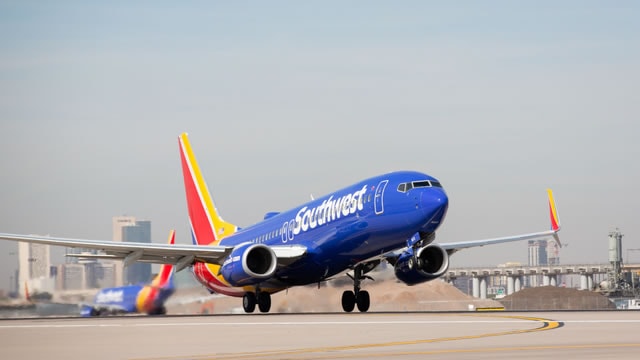
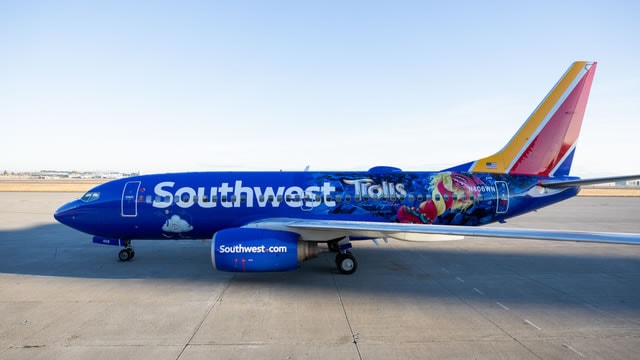
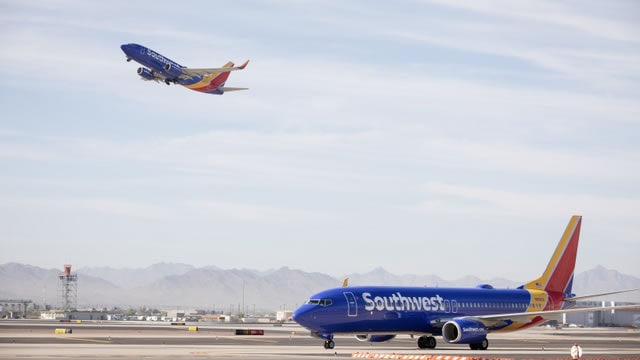
Southwest Airlines is the largest domestic air carrier in the United States by passengers boarded. Southwest operates nearly 800 aircraft in an all-Boeing 737 fleet. Despite offering some longer routes and a few perks for business travelers, the airline predominantly specializes in short-haul, leisure flights operated with a simple cabin configuration in a point-to-point network. In early 2026, Southwest modified its cabins to offer some rows with extra legroom, its ticketing process and merchandising to offer assigned seats, and more fare categories to include a basic economy class that appears for the first time in travel aggregators' search results and more directly competes with other airlines' offerings.
- Ticker
- $LUV
- Sector
- Mobility
- Primary listing
- NYSE
- Employees
- 73,456
- Headquarters
- Dallas, United States
- Website
- www.southwest.com
LUV Metrics
BasicAdvanced
$20B
24.98
$1.60
1.12
$0.72
1.81%
Price and volume
Market cap
$20B
Beta
1.12
52-week high
$55.11
52-week low
$29.26
Average daily volume
6.5M
Dividend rate
$0.72
Financial strength
Current ratio
0.489
Quick ratio
0.378
Long term debt to equity
0.628
Total debt to equity
0.973
Dividend payout ratio (TTM)
44.21%
Interest coverage (TTM)
7.52%
Profitability
EBITDA (TTM)
2,338
Gross margin (TTM)
22.40%
Net profit margin (TTM)
2.78%
Operating margin (TTM)
3.63%
Effective tax rate (TTM)
21.56%
Revenue per employee (TTM)
$410,000
Management effectiveness
Return on assets (TTM)
2.32%
Return on equity (TTM)
11.10%
Valuation
Price to earnings (TTM)
24.981
Price to revenue (TTM)
0.672
Price to book
2.75
Price to tangible book (TTM)
3.19
Price to free cash flow (TTM)
-49.752
Free cash flow yield (TTM)
-2.01%
Free cash flow per share (TTM)
-0.802
Dividend yield (TTM)
1.81%
Forward dividend yield
1.81%
Growth
Revenue change (TTM)
9.47%
Earnings per share change (TTM)
140.24%
3-year revenue growth (CAGR)
6.16%
10-year revenue growth (CAGR)
3.99%
3-year earnings per share growth (CAGR)
19.18%
10-year earnings per share growth (CAGR)
-8.23%
3-year dividend per share growth (CAGR)
10.06%
10-year dividend per share growth (CAGR)
8.28%
What the Analysts think about LUV
Analyst ratings (Buy, Hold, Sell) for Southwest Airlines stock.
Analyst projections of the future price of Southwest Airlines stock.
Bulls say / Bears say
Southwest’s shift to paid seating and bag fees is lifting revenue: second-quarter operating revenue reached a record $8.4 billion, while adjusted unit revenue rose 20.1% year on year. Around 60% of customers bought up from the base product in the first quarter, versus about 20% in 2025. (Southwest Airlines, Southwest Airlines)
The airline is attracting more business and loyalty activity, which could support revenue beyond leisure fares. Managed business revenue rose 30% year on year in the second quarter, while Rapid Rewards enrolments increased 35%. (Southwest Airlines)
Southwest’s credit outlook has improved as its earnings and cash generation strengthen. S&P revised its outlook to stable from negative, citing successful cost and revenue initiatives and expecting continued earnings growth in 2027. (Investing.com)
Higher fuel costs have already forced Southwest to lower its full-year adjusted EPS outlook from at least $4 to $3.25–$4.25. Second-quarter fuel expense rose $889 million year on year, a $1.17 per-share headwind to adjusted earnings. (Southwest Airlines)
Fuel pressure is also curbing growth: Southwest has roughly halved its planned 2026 capacity increase and may cut further if fuel stays high. Less flying could constrain its ability to grow revenue even while it removes weaker routes to protect margins. (Reuters)
Southwest risks weakening the customer loyalty that helped distinguish it from rivals as it adds fees and assigned seats. A 2026 customer-satisfaction survey recorded a fall in Southwest’s score and cited slippage in service perceptions amid criticism of the policy changes. (USA Today)
Data summarised monthly by Lightyear AI. Last updated on 20 Oct 2026.
LUV Financial Performance
Revenues and expenses
LUV Earnings Performance
Company profitability
Upcoming events
No upcoming events
LUV News
AllArticlesVideos
Funds containing LUV
AllUSDEURGBP
Fund name | Fund size | $LUV weighting |
|---|---|---|
iShares S&P 500 Industrials Sector£IISU | $787M | 0.36% |
iShares S&P 500 Industrials Sector€2B7C | $787M | 0.36% |
Xtrackers S&P 500 Equal Weight£XDWE | $16B | 0.20% |
Xtrackers S&P 500 Equal Weight$XDEW | $16B | 0.20% |
iShares S&P 500 Equal Weight€O4J0 | $5.1B | 0.20% |
Data displayed above is indicative only and its accuracy or completeness is not guaranteed. Actual execution price may vary. Past performance is not indicative of future results. Your return may be affected by currency fluctuations and applicable fees and charges. Capital at risk.
Real-time US market data is sourced from the IEX order book provided by Polygon. After-hours US market data is 15 minutes delayed and may differ significantly from the actual tradable price at market open.