Unilever/$UL
1D1W1M3M6MYTD1Y5YMAX
Capital at risk
About Unilever
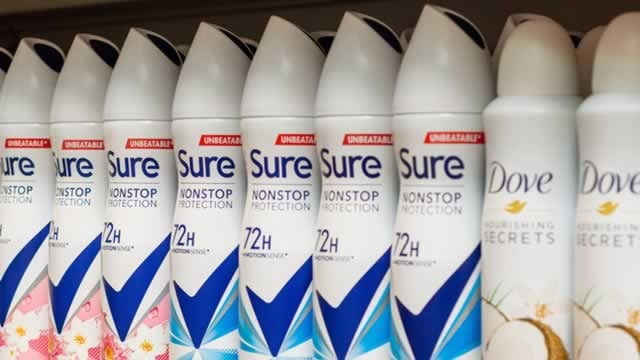
Unilever is a diversified beauty, well-being, and personal care (51% of 2025 sales by value), homecare (23%), and packaged food (26%) company. Its brands include Dove personal-care products, Knorr soups and sauces, Hellmann's mayonnaise, Axe and Rexona deodorants, and TRESemmé haircare. The firm has been acquisitive in recent years; notable purchases include Paula's Choice, Liquid I.V., Horlicks, and Wild deodorants. The company derives 58% of its sales from emerging markets and 42% from developed markets. The US is its largest market, accounting for around 20% of sales, followed by India, which accounts for 11% of sales.
- Ticker
- $UL
- Sector
- Consumer Essentials
- Primary listing
- NYSE
- Employees
- 93,732
- Headquarters
- London, United Kingdom
- Website
- www.unilever.com
Unilever Metrics
BasicAdvanced
$143B
14.13
$4.74
0.45
$2.14
3.14%
Price and volume
Market cap
$143B
Beta
0.45
52-week high
$74.98
52-week low
$54.75
Average daily volume
3.2M
Dividend rate
$2.14
Financial strength
Current ratio
0.74
Quick ratio
0.568
Long term debt to equity
1.309
Total debt to equity
1.754
Dividend payout ratio (TTM)
45.85%
Interest coverage (TTM)
8.79%
Profitability
EBITDA (TTM)
12,189.603
Gross margin (TTM)
47.07%
Net profit margin (TTM)
18.32%
Operating margin (TTM)
20.03%
Effective tax rate (TTM)
30.59%
Revenue per employee (TTM)
$605,220
Management effectiveness
Return on assets (TTM)
8.29%
Return on equity (TTM)
31.87%
Valuation
Price to earnings (TTM)
14.134
Price to revenue (TTM)
2.571
Price to book
6.62
Price to tangible book (TTM)
-5.39
Price to free cash flow (TTM)
18.557
Free cash flow yield (TTM)
5.39%
Free cash flow per share (TTM)
3.611
Dividend yield (TTM)
3.19%
Forward dividend yield
3.14%
Growth
Revenue change (TTM)
8.01%
Earnings per share change (TTM)
76.96%
3-year revenue growth (CAGR)
-5.97%
10-year revenue growth (CAGR)
-0.38%
3-year earnings per share growth (CAGR)
0.80%
10-year earnings per share growth (CAGR)
6.81%
3-year dividend per share growth (CAGR)
-0.47%
10-year dividend per share growth (CAGR)
4.23%
What the Analysts think about Unilever
Analyst ratings (Buy, Hold, Sell) for Unilever stock.
Analyst projections of the future price of Unilever stock.
Bulls say / Bears say
Unilever’s volume recovery is becoming more convincing: second-quarter underlying sales rose 5.8%, including 5.5% volume growth, and management raised its 2026 outlook to 4%–6% growth. This gives the turnaround stronger evidence than price increases alone. (Reuters)
Growth is broadening beyond one brand or region: all business groups recorded volume-led growth in the first half, while India delivered 8% underlying sales growth and Power Brands grew 6%. That spread could help Unilever convert its emerging-market reach and leading brands into sustained growth. (SEC)
The planned Foods separation could leave Unilever with a more focused home and personal care business, while combining Foods with McCormick is expected to generate about $600 million of annual cost synergies. Successful execution could sharpen investment behind faster-growing categories. (Unilever)
Reported results are weaker than underlying growth suggests: first-half turnover rose just 0.5% as currency reduced it by 4.9%, and diluted earnings per share fell 2.5%. Persistent currency pressure could continue to obscure operational progress for dollar-based investors. (SEC)
Cost inflation is already pressuring profitability: first-half gross margin fell 70 basis points to 46.8%, with commodity costs partly offsetting productivity gains. Management expects second-half growth to be led by pricing, leaving a risk that price increases fail to fully protect margins or volumes. (SEC)
Foods is a weak spot ahead of a complicated separation: first-half sales growth was only 1.2%, developed-market foods declined, and Unilever cited lost share in US condiments. The separation also carries expected stranded costs of €400–500 million and around €500 million of one-off restructuring costs. (SEC, Unilever)
Data summarised monthly by Lightyear AI. Last updated on 22 Oct 2026.
Unilever Financial Performance
Revenues and expenses
Unilever Earnings Performance
Company profitability
Upcoming events
No upcoming events
Unilever News
AllArticlesVideos

Funds containing Unilever
Fund name | Fund size | $UL weighting |
|---|---|---|
iShares AEX€IAEX | €781M | 12.50% |
iShares AEX£IAEX | €781M | 12.50% |
Data displayed above is indicative only and its accuracy or completeness is not guaranteed. Actual execution price may vary. Past performance is not indicative of future results. Your return may be affected by currency fluctuations and applicable fees and charges. Capital at risk.
Real-time US market data is sourced from the IEX order book provided by Polygon. After-hours US market data is 15 minutes delayed and may differ significantly from the actual tradable price at market open.