SpaceX/$SPCX
1D1W1M3M6MYTD1Y5YMAX
Capital at risk
About SpaceX
Founded in 2002 and commonly known as SpaceX, the Space Exploration Technologies Corporation designs, manufactures, and operates a family of reusable rockets to launch various payloads into Earth orbit for government and commercial customers. Starting in 2019, the company began launching a constellation of its own communication satellites to provide mobile broadband and wireless services under the Starlink brand. In early 2026, the company acquired xAI from its founder, Elon Musk, which operates a large language artificial intelligence model named Grok, a gigawatt-scale data center called Colossus, and the social media network X.
- Ticker
- $SPCX
- Sector
- Communication
- Primary listing
- NASDAQ
- Employees
- 21,000
- Headquarters
- Starbase, United States
- Website
- www.spacex.com
SpaceX Metrics
BasicAdvanced
$2T
-
-$0.55
-
-
Price and volume
Market cap
$2T
52-week high
$225.64
52-week low
$104.83
Average daily volume
102M
Financial strength
Current ratio
3.084
Quick ratio
2.89
Long term debt to equity
0.204
Total debt to equity
0.22
Interest coverage (TTM)
-0.26%
Profitability
EBITDA (TTM)
11,736
Gross margin (TTM)
56.75%
Net profit margin (TTM)
-8.61%
Operating margin (TTM)
1.79%
Effective tax rate (TTM)
11.45%
Revenue per employee (TTM)
$1,530,000
Management effectiveness
Valuation
Price to revenue (TTM)
28.397
Price to book
11.28
Price to tangible book (TTM)
16.35
Price to free cash flow (TTM)
-22.659
Free cash flow yield (TTM)
-4.41%
Free cash flow per share (TTM)
-6.483
Growth
What the Analysts think about SpaceX
Analyst ratings (Buy, Hold, Sell) for SpaceX stock.
Analyst projections of the future price of SpaceX stock.
Bulls say / Bears say
Starlink remains a sizeable, profitable growth business: connectivity revenue rose 69% year on year to $5.25 billion, while subscribers reached 13.6 million and quarterly average revenue per user increased to $69 from $66. Its growing aviation, enterprise and government services add ways to expand beyond household broadband. (CNBC, NBC News)
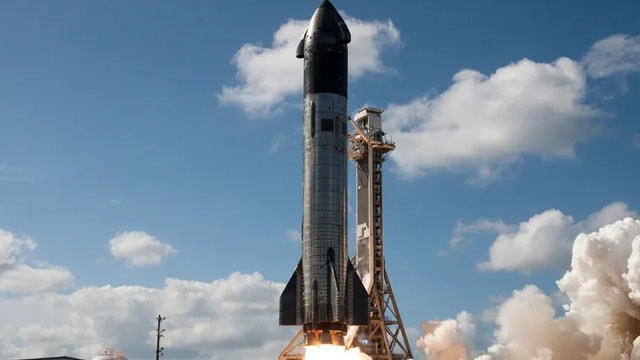
Starship made technical progress on Test Flight 14, reaching orbit and deploying dozens of next-generation Starlink satellites. If further testing makes the rocket reliable and reusable, it could support the company’s plans to expand satellite capacity. (CNBC)
The AI expansion is exceptionally capital-intensive: SpaceX spent $19.6 billion on capital expenditure in the third quarter, including $16.4 billion on AI, and said spending should remain near that level in the near term. Returns therefore depend on sustaining demand for compute while financing a huge infrastructure build-out. (NBC News, CNBC)
Starlink’s average monthly revenue per subscriber has fallen from $99 in 2023 to $69, as international expansion brings lower-priced plans. Continued pricing pressure could make subscriber growth less valuable even as the network expands. (NBC News)
Much of the AI segment’s sales currently come from renting computing capacity, while SpaceX’s Grok products have been overshadowed by established rivals. That leaves the business exposed if compute demand weakens or it cannot build a stronger position in AI software. (NBC News)
Data summarised monthly by Lightyear AI. Last updated on 22 Oct 2026.
SpaceX Financial Performance
Revenues and expenses
SpaceX Earnings Performance
Company profitability
Upcoming events
No upcoming events
SpaceX News
AllArticlesVideos


Funds containing SpaceX
AllUSDEURGBP
Fund name | Fund size | $SPCX weighting |
|---|---|---|
iShares AI Innovation Active£IART | $304M | 3.54% |
Global X Artificial Intelligence$AIQU | $88M | 3.46% |
Global X Artificial Intelligence£AIQG | $88M | 3.46% |
Xtrackers Nasdaq 100€XNAS | $2.5B | 2.78% |
Xtrackers Nasdaq 100£XNAQ | $2.5B | 2.78% |
Data displayed above is indicative only and its accuracy or completeness is not guaranteed. Actual execution price may vary. Past performance is not indicative of future results. Your return may be affected by currency fluctuations and applicable fees and charges. Capital at risk.
Real-time US market data is sourced from the IEX order book provided by Polygon. After-hours US market data is 15 minutes delayed and may differ significantly from the actual tradable price at market open.