
What is a gilt?
Gilts are UK government bonds, issued by the UK Debt Management Office (DMO) on behalf of HM Treasury. When you buy one, you're lending money to the UK government to help fund public spending.
In return, you receive a fixed rate of interest (called the coupon) usually paid twice a year. On an agreed future date, known as the maturity date, you get the gilt’s face value back in full, no matter what you originally paid for it. This is because gilts can trade at a price that is above (premium) or below (discount) their face value. The price is determined by the market and is influenced by the interest rate environment.
Gilts are issued across a wide range of maturities, up to 30 years and beyond.
How does the price work?
A gilt's nominal (face) value and the price you actually pay for it are two different things. Gilts trade on the open market, so the price moves up and down, mostly with interest rate changes.
For example, if a gilt is issued at £100, depending on market conditions it may trade at a price above or below this. If an investor buys a gilt that is trading below (called a discount) its face value - for example £80 - then they will still get £100 when the gilt matures. Equally, if an investor buys a gilt that is trading above (called a premium) its face value - for example £120 - they will still only get £100 back at the maturity date.
When interest rates go up, gilt prices tend to go down. A gilt issued years ago with a lower coupon becomes less attractive next to newer gilts paying more, so its price falls until the overall return (coupon plus the gain at maturity from that lower price back up to its face value is competitive again.
When interest rates go down, the opposite happens. Existing gilts with higher coupons become more attractive than newer, lower-paying ones, so their price rises.
If you hold a gilt to maturity, none of that matters day to day. You know today what it will pay you and when, since the coupon rate, payment dates and repayment date are all fixed when the gilt is issued (assuming the UK government doesn’t default). Sell before maturity, and you get whatever the market price happens to be at that moment, which could be higher or lower than what you paid. If interest rates have risen since purchase, you will likely sell at a discount (a capital loss). If rates have fallen, you may sell at a premium (a capital gain).
Gilt yields are shown as both yield to maturity (showing the full return an investor receives when holding a gilt to maturity) and running yield (coupon divided by the clean price). It’s important to remember that a gilt’s coupon is fixed when it’s first issued, but the yield will change as gilt prices change.
The tax advantage
This is where gilts start to look different from most other investments, and it's the main reason they matter for people who've used up their ISA allowance.
Investing in a gilt gives you two types of return, which are taxed differently:
- The coupon. This is your fixed interest payment. Outside an ISA, it's taxed as income, at your normal rate.
- The capital gain. This is the difference between what you paid for the gilt and the £100 you get back at maturity (if you bought it below £100). For individual investors, this gain is completely free of Capital Gains Tax. No ISA required.
That split means the same headline return can look very different depending on which gilt you hold. A low-coupon gilt bought at a discount (below £100) delivers more of its return as that tax-free capital gain. A higher-coupon gilt delivers more as taxable coupon income.
Because the capital gains exemption doesn't require an ISA, some gilts can extend tax-advantaged investing beyond your £20,000 annual ISA allowance, which is one reason they're particularly useful once that's maxed out. If you do hold gilts in an ISA, the wrapper's benefit is sheltering the coupon from income tax, since the capital gain is already exempt either way. There's also no stamp duty or Stamp Duty Reserve Tax when you buy a gilt.
For businesses, the tax treatment is different: both income and gains are taxed under standard corporation tax rules, rather than the personal tax treatment above.
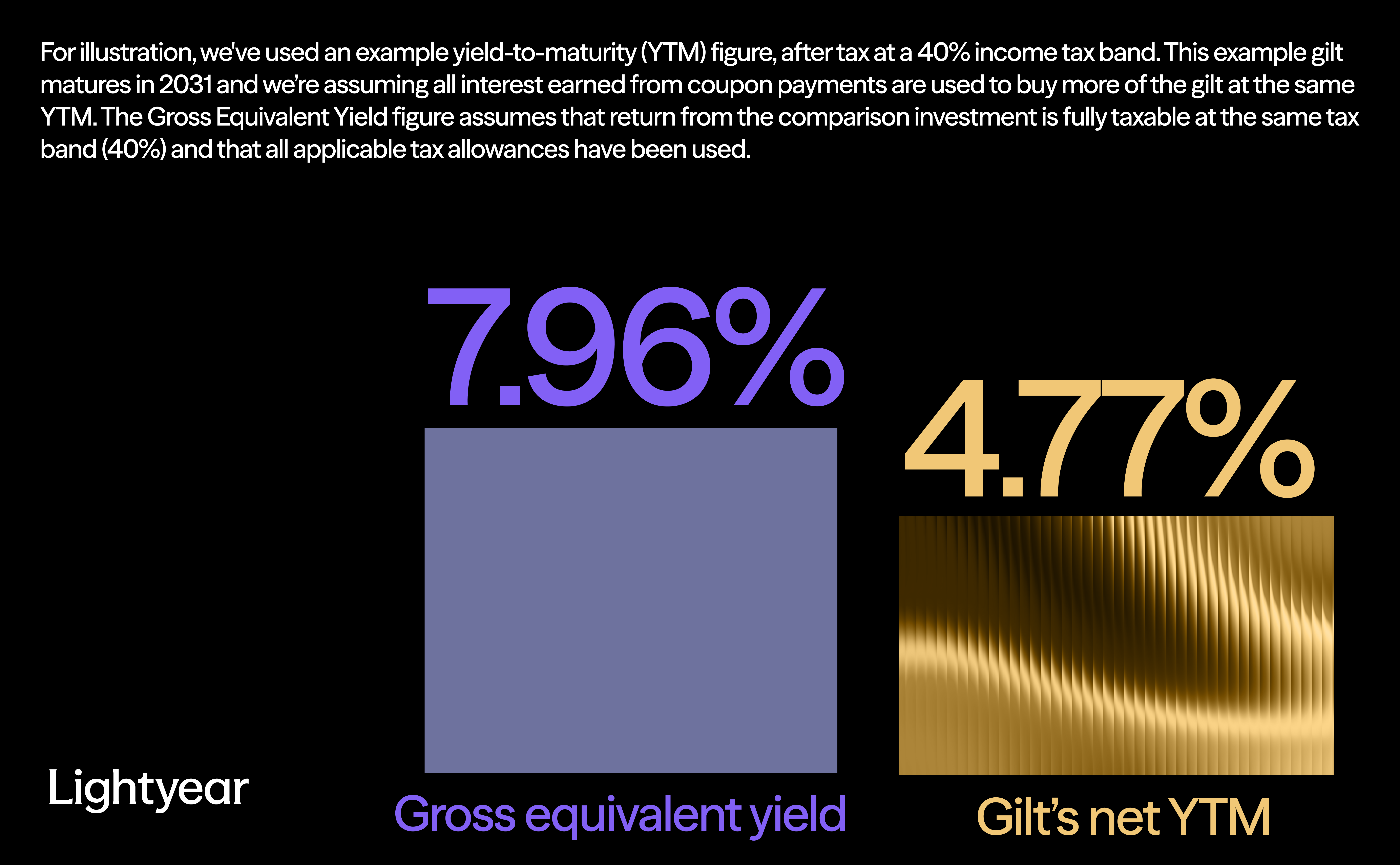
As a higher rate taxpayer, to match a gilt yielding 4.77% after tax, you’d have to find a fully taxable investment yielding roughly 7.96% pre-tax
It’s important to understand how tax impacts your returns. Let's take an example with made up numbers. You’re an investor within the 40% tax bracket, who bought a gilt at a discounted price (below nominal face value), maturing in 2031, and held it until maturity. Let’s say this makes your net yield-to-maturity (YTM) roughly 4.77%.
To match that yield with a fully taxable investment, you’d need to find one yielding 7.96% before taxes. That’s called gross equivalent yield (GEY), and it’s a big difference.
How is GEY calculated?
GEY is used to give an approximate indication of what return an investor would need to earn on a fully taxable investment (like a savings account or corporate bond) to match the after-tax annualised return of the gilt when held to maturity. How it is calculated depends on the investor’s income tax band.
It is calculated by subtracting the gilt yield-to-maturity from the tax band (40% in the example we’ve used) multiplied by the gilt’s coupon and then dividing this result by the net retention factor after tax (e.g. 0.60 for 40% tax band).
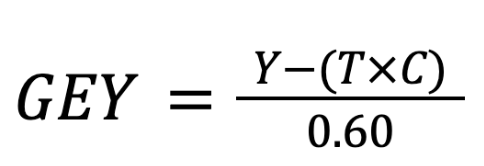
- Y = Gilt Yield-to-maturity (e.g., 4.71%)
- C = Coupon Rate (e.g., 0.625%)
- T = Tax Rate on Income (e.g., 40% or 0.40)
- 0.60 = The net retention factor after tax (1-0.40=0.60)
Tax treatment depends on individual circumstances and may change in the future.
Are there risks?
There's no such thing as a risk-free investment, but gilts are generally seen as low risk. The UK government is considered highly unlikely to default, and has always paid the interest and principal owed on its gilts to date.
One thing to keep in mind is the length of the maturity. The longer you have until a gilt matures, the more its price moves with interest rate changes. If you need to sell before maturity, the price you get will depend on market conditions at that time, so your actual return could be lower or higher than expected.
Inflation is worth watching too. A gilt's coupon and repayment are fixed, so if inflation runs higher than your return, your money won't stretch as far as it would have otherwise, even though you get back exactly what you were promised.
Gilts on Lightyear
Lightyear gives you access to 20 gilts, spanning short to long maturities and a full range of coupons, low to high. They sit directly alongside your stocks, ETFs and Vaults, so you can seamlessly add a government-backed, fixed-income instrument to your existing portfolio if it fits your needs.
Who are gilts for?
For the investor who's maxed out their ISA. Once you've used your £20,000 allowance, most tax advantages run out. Gilts don't stop there. Low-coupon gilts in particular offer a way to keep investing tax-efficiently, without a wrapper limit.
For the investor planning towards a goal. Because a gilt's coupon and maturity date are fixed from the start, you know roughly what it will pay and when. Build a ladder of gilts maturing when you'll need the money, whether that's a tax bill, school fees, or retirement, and you can plan around those dates with more certainty than most investments allow.
For businesses managing company cash. Cash sitting in a current account earns nothing while it waits for the next tax bill or payroll run. Gilts let you match that cash to a fixed, government-backed return timed to when you'll actually need it back, alongside Money Market Funds for whatever needs to stay liquid. Note that gilts are subject to corporate tax for businesses, as the tax advantage only applies to individual investors.