
Important
Investing involves risk. Gilt prices move as interest rates change. Timing and rates affect returns; you may get back less than invested.
This is not tax advice. Tax treatment depends on your personal circumstances and may change in future. Get professional advice if you’re unsure. Available in the UK only.
Here’s how gilts work:
- Predictable, timed income. A fixed coupon twice a year, and the gilt's face value paid back to you on a set date.
- Low risk. Your returns are provided by the UK government.
- Tax efficient, even outside an ISA. Any capital gain on a gilt is completely free of Capital Gains Tax for individual investors, no ISA required. Only the biannual coupon (that’s the interest payment) is taxed as income.
Because of the tax treatment, low coupon gilts may offer a tax advantaged gain for investors within higher income tax brackets.
For years in a low interest environment, gilts sat quietly inside pension funds and advised portfolios, a low-key way to hold UK government debt. Then rates started climbing and by today, gilt yields have hit their highest levels in decades, bringing them back into the financial pages as an income option.
We've seen that shift too. Requests for gilts from our customers have picked up pace right alongside rising rates and increasing buzz around gilts in the financial world.
Ladder your future income with a range of gilts on Lightyear
- Choice across the curve. We offer 20 gilts, with maturity dates from a few months to thirty years out. Pick based on how long you want to lend for, and how you want the return split between steady income and one-time payment at maturity.
- No order fee. Personal accounts trade gilts free of charge. Businesses pay a flat £1.
- Available for individual and business investors. Gilts sit directly alongside your stocks, ETFs and Vaults. For businesses, when paired with Money Market Funds, they create a seamless treasury product.
For the investor taking tax advantages beyond an ISA
Most tax-efficient investing stops at the £20,000 ISA allowance, but gilts go further, allowing you to keep more of your return. The Capital Gains Tax exemption (relevant when gilts are bought at a price below their redemption value - where the difference between what you paid for a gilt and the nominal value you get back at maturity isn’t taxed) applies whether a gilt sits inside a wrapper or not. That means a low-coupon gilt bought at a discount can deliver a tax-advantaged return long after your ISA is full.
It's a big part of why gilts are drawing attention from higher earners who've run out of tax benefits elsewhere.
For the investor planning towards a goal
A gilt's coupon and maturity date are fixed from the day you buy it, so you already know what it pays and when. Build a ladder of gilts maturing around the moments you're planning for: a tax bill, school fees, retirement, and each one lands right onschedule. It's a way to plan around important dates, instead of hoping the market cooperates when you need the money.
For businesses managing company cash
Every business holds cash earmarked for something. But when left in a current account, it earns nothing while waiting to be used. Gilts let you match that cash to a fixed return that lands exactly when you need it, and pair naturally with Money Market Funds on Lightyear.
What you need in the shorter term stays with MMFs, everything else works towards the gilt’s maturity date. Note that both gains and income from gilts are subject to corporate tax for businesses, as the CGT tax exemption on gains only applies to individual investors.
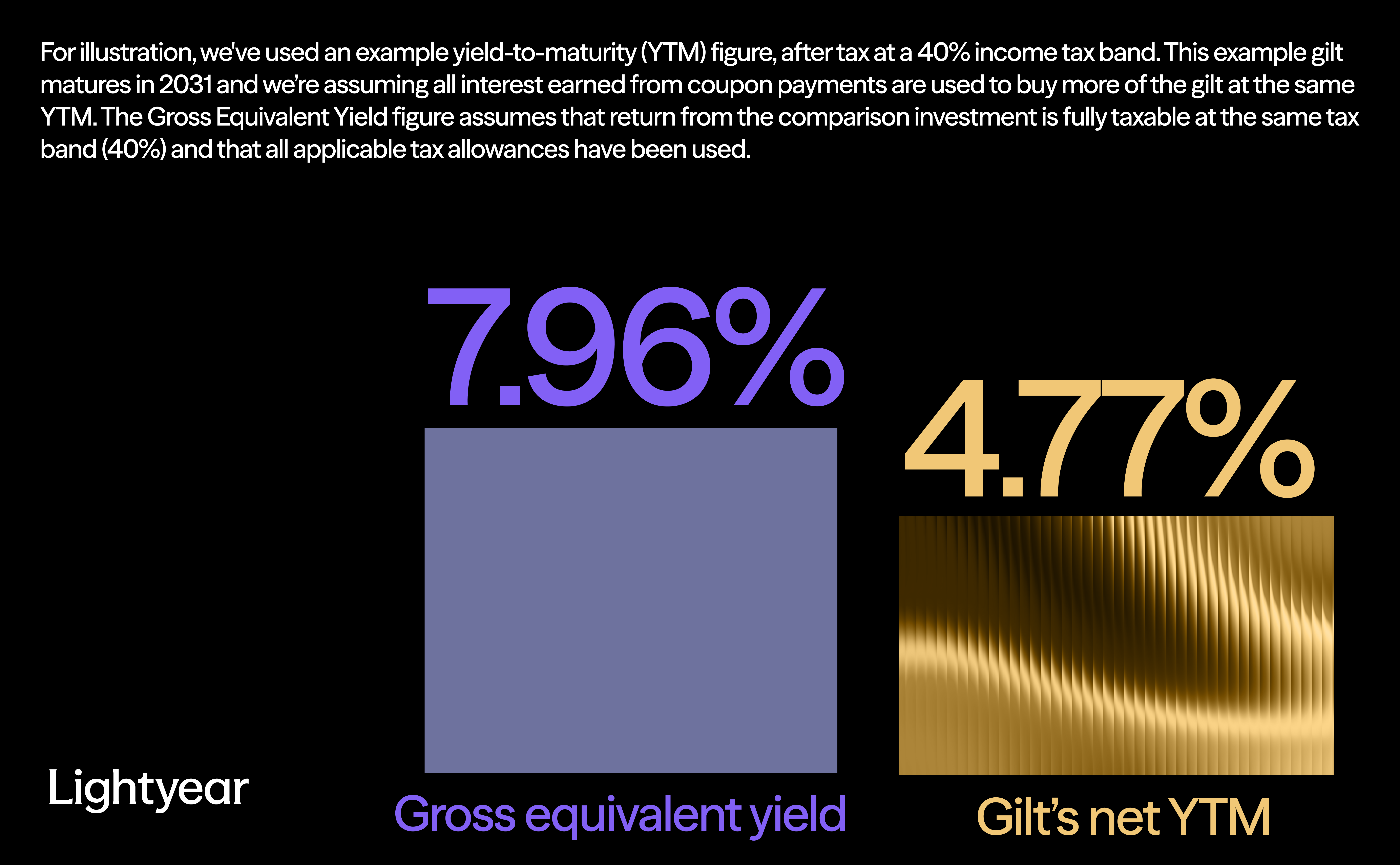
As a higher rate taxpayer, to match a gilt yielding 4.77% after tax, you’d have to find a fully taxable investment yielding roughly 7.96% pre-tax
It’s important to understand how tax impacts your returns. Let's take an example with made up numbers. You’re an investor within the 40% tax bracket, who bought a gilt at a discounted price (below nominal face value), maturing in 2031, and held it until maturity. Let’s say this makes your net yield-to-maturity (YTM) roughly 4.77%.
To match that yield with a fully taxable investment, you’d need to find one yielding 7.96% before taxes. That’s called gross equivalent yield (GEY), and it’s a big difference.
How is GEY calculated?
GEY is used to give an approximate indication of what return an investor would need to earn on a fully taxable investment (like a savings account or corporate bond) to match the after-tax annualised return of the gilt when held to maturity. How it is calculated depends on the investor’s income tax band.
It is calculated by subtracting the gilt yield-to-maturity from the tax band (40% in the example we’ve used) multiplied by the gilt’s coupon and then dividing this result by the net retention factor after tax (e.g. 0.60 for 40% tax band).
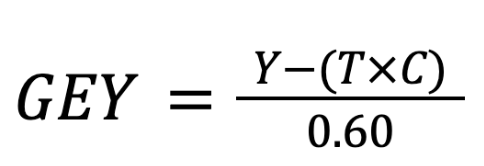
- GEY = Gross Equivalent Yield
- Y = Gilt Yield-to-maturity (e.g., 4.71%)
- C = Coupon Rate (e.g., 0.625%)
- T = Tax Rate on Income (e.g., 40% or 0.40)
- 0.60 = The net retention factor after tax (1-0.40=0.60)
Tax treatment depends on individual circumstances and may change in the future.
A fixed coupon, a known maturity date, and a return you can plan around, whether that's for a future goal, a more tax-efficient portfolio, or company cash waiting on its next use. Gilts are live now on Lightyear to help with it all.